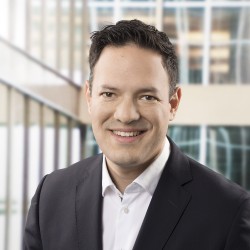
Francisco Rivadeneyra is the Senior Director for Payments Policy and Research in the Payments and Regulatory Oversight department. He leads the policy function of the department, which is tasked with anticipating emerging issues and guiding the Bank's strategic decisions on payments. This work is grounded in economic research and technical experimentation.
His research spans payment systems design, digital currencies, and the role of new technologies such as AI and quantum computing in finance and central banking.
Francisco holds a PhD in economics from the University of Chicago.
We study the competition between a welfare-maximizing public payment platform (e.g., CBDC or fast payment system) and a profit-maximizing private platform in a two-sided market, deriving optimal public pricing and showing how network effects, fragmentation, and policy mandates like zero fees or cost recovery shape welfare, usage, and fee incidence.
This note analyzes different economic models of a central bank digital currency (CBDC) ecosystem where the central bank chooses different levels of market involvement and usage of policy levers. The analysis suggests that there are trade-offs between the costs to the central bank and its ability to achieve policy goals like universal access.
A well-functioning monetary system is characterized by public and private forms of money that exchange at par as value flows freely between them. A relevant retail public money—whether in the form of cash, a central bank digital currency or both—is a necessary component of such a monetary system.
We review the nascent but fast-growing literature on central bank digital currencies (CBDCs), focusing on their potential impacts on private banks. We evaluate these impacts in three areas of traditional banking: payments, lending and liquidity and maturity transformation. We also take a broader look at CBDCs and highlight two promising directions for future research.
We develop an algorithm and run it on a hybrid quantum annealing solver to find an ordering of payments that reduces the amount of system liquidity necessary without substantially increasing payment delays.
We study the impact of the Bank of Canada’s choice of settlement mechanism in Lynx on participant behaviors, liquidity usage, payment delays and the overall operational efficiency of the new system.
This article provides an overview of the growth of Canadian-dollar-denominated assets in official foreign reserves. Based on International Monetary Fund data and on internal Bank of Canada analysis, we estimate that the total reserve holdings of Canadian-dollar assets increased from negligible levels before 2008 to around US$200 billion in the third quarter of 2013. We discuss the determinants of this increase, as well as its potential impact on Canadian debt markets, for example, lower yields and therefore reduced financing costs for the Government of Canada, and the possible negative impact on market liquidity.
The Bank of Canada recently developed an asset-liability-matching model to aid in the management of Canada’s foreign exchange reserves. The model allows policy-makers at the Bank and the Department of Finance to analyze asset-allocation and funding-mix decisions by quantifying both the risk-return and liquidity trade-offs for the assets, as well as the risk-cost trade-offs of the funding liabilities.
"Government Bond Clienteles and Yields" (with Jianjian Jin and Jesus Sierra), In Advances in the Practice of Public Investment Management, Palgrave, 2018
"Financial Development, Credit, and Business Cycles" (with Tiago Pinheiro and Marc Teignier), Journal of Money, Credit and Banking, 2017, 49 (7), 1653-1665.
"Monopolies and Economic Growth" (in Spanish) (with Pablo Pena), Gaceta de Economía, Fall 2009.
"An Empirical Analysis of the Law of One Price in Mexico" (in Spanish) (with Marco González-Navarro), Gaceta de Economía, Fall 2004.
"Trade Creation and Trade Diversion of Preferential Agreements: New Estimates for NAFTA" (in Spanish) (with Jose M. Chavez), Gaceta de Economía, Spring 2002.
Work in progress
"Payments System Design Using Reinforcement Learning" (with Ajit Desai, Hand Du and Rod Garratt).
"E-Money and Payments Policy" (with Charles M. Kahn and Russell Wong).
"Intraday Trade Dynamics in Short-term Funding Markets" (with Mark Rempel).
"Foreign Reserves and Tail Risk" (with Jorge Cruz Lopez).
We use cookies to help us keep improving this website.