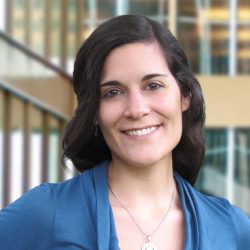
Gabriela Galassi is a Senior Economist in the Labour and Inflation Team of the Canadian Economic Analysis Department at the Bank of Canada. Her research interests include labour economics, applied econometrics and big data. She received her Ph.D. in Economics from the European University Institute in Florence in 2018.
AI has the potential to reshape the labour market by automating some tasks for many workers. Even though evidence of a significant impact on the labour market remains limited, AI appears to be making it harder for some Canadians to find work in occupations that are most exposed to it.
In the field of economics, on average, women tend to produce fewer research articles and be cited less often than men. But this appears to be changing. A newly compiled dataset about scholars at top universities around the world helps us identify where individual gender gaps exist.
In recent years, significant efforts have been made to attract more women into academia and to support their careers, with the goal of increasing their representation.
When it comes to understanding the influence of labour costs on inflation, average wage growth is a misleading indicator because it is affected by composition effects. We propose an alternative measure that corrects for these effects by using microdata from the Labour Force Survey. Our new measure has many desirable properties, including reduced volatility and a better relationship with labour market fundamentals.
We assess the health of the Canadian labour market. We find that it has seen gradual but material easing since 2023, amid some signs of structural changes.
In this paper, the authors assess the relationship between digitalization and labour demand and supply, and how this relationship affects wages and income inequality. We also explore implications of recent digitalization trends for the future of work.
More education typically leads to higher pay, but as more people become educated, wages can decrease. Your education choices significantly affect your future earning potential.