Carolyn A. Wilkins - Latest
-
June 12, 2014
Financial System Review - Press Conference (Video) - June 2014
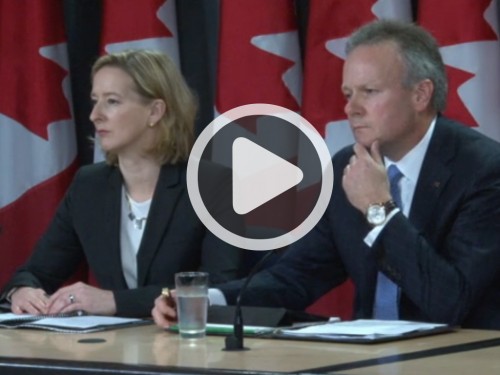
Press conference by Governor Stephen S. Poloz and Senior Deputy Governor Carolyn Wilkins (11:15 (ET) approx.)
-
-
-
-
June 20, 2010
The Bank of Canada’s Extraordinary Liquidity Policies and Moral Hazard
Bank of Canada published a report establishing a set of principles to guide the extraordinary liquidity interventions it was making in response to the systemic shocks buffeting the Canadian financial system. These principles provided a framework for maintaining consistency between the Bank’s actions and its responsibilities as lender of last resort to the financial system, while allowing sufficient fl exibility to respond to the unique challenges of the crisis. -
-
-
September 11, 2009
Bank of Canada Liquidity Actions in Response to the Financial Market Turmoil
In response to the financial crisis of 2007-09, the Bank of Canada intervened repeatedly to stabilize the financial system and limit the repercussions of the crisis on the Canadian economy. This article reviews the extraordinary liquidity measures taken by the Bank during this period and the principles that guided the Bank's interventions. A preliminary assessment of the term liquidity facilities provided by the Bank suggests that they were an important source of liquidity support for some financial institutions and, on a broader basis, served to reduce uncertainty among market participants about the availability of liquidity, as well as helping to promote a return to well-functioning money markets. -
June 21, 2008
Financial Market Turmoil and Central Bank Intervention
In this article, we consider central bank intervention to address financial market turmoil with a focus on the questions of why, when, and how a central bank might intervene. We set out a policy framework and identify appropriate central bank instruments to respond to extraordinary financial market turmoil, consistent with central bank policy goals and functions. -
June 2, 2006
Another Look at the Inflation-Target Horizon
The conduct of monetary policy within an inflation-targeting framework requires the establishment of an inflation-target horizon, which is the average time it takes inflation to return to the target. Policy-makers have an interest in communicating this horizon, since it is likely to help anchor inflation expectations. This article focuses on the determination of the appropriate policy horizon by reporting on two recent Bank of Canada studies. The evidence suggests that the current target horizon of six to eight quarters remains appropriate. It is important to note that the duration of the optimal inflation-target horizon varies widely, depending on the combination of shocks to the economy. In rare cases when the financial accelerator is triggered by a persistent shock, such as an asset-price bubble, it may be appropriate to take a longer view of the inflation-target horizon.