Polymer

Polymer Series (2011)

Benefits For You

Polymer notes carry benefits that you’ll appreciate as you make those basic transactions of everyday life.

Security

How to Check Notes

Feel. Look. Flip.

The new $100 and $50 polymer notes are easy to check and hard to counterfeit. They have the same innovative security features that can be seen in transparent areas on both sides of the notes.

Feel

  • 1. Raised ink

    Feel the raised ink on the shoulders of the large portrait, the large number, and the words “Bank of Canada” and “Banque du Canada.”

Look

  • 2. Large window

    Look for transparency through the large window containing a metallic portrait and building.

  • 3. Metallic portrait

    Look at the details in the metallic portrait in the large window. It matches the large portrait.

  • 4. Metallic building

    Look at the details in the metallic building in the large window. Tilt the note to see sharp colour changes in the building.

  • 5. Small numbers

    Look at the numbers in and around the large window that match the value of the note. Some of the numbers appear in reverse.

  • 6. Transparent text

    Look at the word “Canada.” It is transparent and feels slightly raised.

  • 7. Maple leaf border

    Look at the maple leaves that border the large window. Some of the leaves cross into the window.

  • 8. Frosted maple leaf window

    Look at the frosted maple leaf window to see that it has a transparent outline.

Flip

Flip the note to see the features in the large window repeated in the same colours and detail on the other side.

Added Security

  • 9. Hidden numbers

    The hidden numbers are a security feature that you can use to further verify your note, with the aid of a single-point light source.

This feature allows you to verify a bank note using many commonly available single-point light sources, such as pot lights and household (incandescent) light bulbs. No light source should be pointed directly at the eye at close range, and dangerous sources of light, such as the sun, laser lights and many LEDs, should never be used to view the feature.

  • Place the frosted maple leaf window close to your eye.

  • Look through the frosted maple leaf window at a single-point light source.

  • See a circle of numbers matching the note’s value appear through the frosted maple leaf window.

Accessibility

Features for the Blind and Partially Sighted

There are several products that explain how blind and partially-sighted Canadians can determine the denominations of bank notes.

You can also call our toll-free line to hear a recording at 1 888 513-8212.

Three key elements in the new polymer notes are designed to help blind and partially-sighted Canadians recognize bank note denominations by touch (tactile feature), sight (large numerals) or electronic signal (bank note reader). These are basically the same accessibility features that were used for the Canadian Journey series, but the tactile feature will last longer, thanks to the durability of polymer, and the bank note reader will work on both ends of the new notes.

Aside from the fact that polymer notes are smoother and lighter than paper notes, a notable change is the new position of the tactile feature. It’s now in the top left corner of the Polymer series notes.

These elements are not security features and should not be used to verify that bank notes are genuine.

  • Touch

    The tactile feature in the top left corner consists of symbols of six raised dots (two columns of three) separated by a smooth surface. This system is not Braille. It was developed in consultation with blind and partially-sighted Canadians after research indicated that not all users read Braille.

    The number and position of these six-dot symbols vary according to the denomination:

    • $5: one six-dot symbol
    • $10: two six-dot symbols
    • $20: three six-dot symbols
    • $50: four six-dot symbols
    • $100: two symbols separated by a smooth surface that is wider than that on the $10 note
  • Sight

    Large high-contrast numerals identifying the note's denomination appear on both sides of each note. A dark numeral on a pale background appears on the front, and a white numeral against a dark background appears on the back. The distinct colours used for each denomination also assist the partially sighted to recognize their bank notes. The colours used for each denomination are consistent with those used for previous series.

  • Electronic Signal

    The Bank of Canada provides a bank note reader to help the blind and partially sighted recognize the denominations of bank notes through machine-readable codes. The user can select from three options for this hand-held device to signal the denomination: voice (English or French), tone or vibration. The new polymer notes are machine readable from both short edges of the note, while Canadian Journey notes can be read only on the left edge (when the side with the large portrait is facing up).

Design

What’s On Canada’s New Polymer Notes?

Canada’s new bank notes evoke the country’s spirit of innovation. The new Polymer series is itself a technical innovation, and its designs celebrate Canada’s achievements at home, around the world and in space. Reflecting the ingenuity, determination and courage of a nation and its people, Canada’s accomplishments extend well past our frontiers.

Polymer Series - $100 Note


$100 Note - Design Features
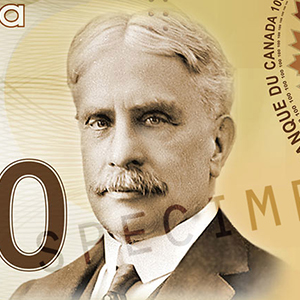
  • Portrait: Sir Robert L. Borden, Prime Minister, 1911–20
  • Signatures: Left – T. Macklem, Right – M.J. Carney
  • Size: 152.4 x 69.85 mm (6.0 x 2.75 inches)
  • Issue Date: November 2011
  • Theme: Medical Innovation
  • Canadians have long been at the frontiers of medical research and as a result have helped to save millions of lives worldwide. Notable Canadian contributions include pioneering the use of insulin to treat diabetes, DNA and genetic research, the invention of the pacemaker, and the first hospital-to-hospital robot-assisted surgery.

    Researcher at a microscope

    The image of a researcher using a microscope depicts Canada’s long-standing commitment to medical research.

    DNA strand

    Deoxyribonucleic acid (DNA) is the genetic blueprint of life. Canadian researchers have been at the forefront of mapping our human genetic makeup in this field of medical science.

    ECG

    This electrocardiogram provides a visual cue to Canada’s contributions to heart health, including the invention of the pacemaker by John Hopps in 1950.

    Insulin

    The discovery of insulin to treat diabetes was made by Canadian researchers Frederick Banting and Charles Best in 1921.

Polymer Series - $50 Note


(image of front and back of $50)

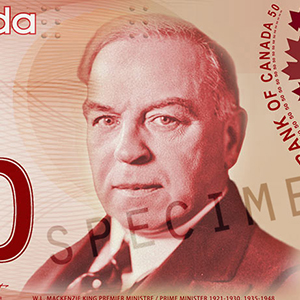
$50 Note - Design Features
  • Portrait: William Lyon Mackenzie King, Prime Minister, 1921–30 and 1935–48
  • Signatures: Left – T. Macklem, Right – M.J. Carney
  • Size: 152.4 x 69.85 mm (6.0 x 2.75 inches)
  • Issue date: March 2012
  • Theme: CCGS Amundsen, Research Icebreaker
  • The vastness and splendour of Canada’s northern frontier have helped to shape our cultural identity. The icebreaker plays an important role in the North, keeping Canada’s historic passages open, undertaking marine search and rescue, supporting isolated communities, and participating in international environmental research. The CCGS Amundsen helps Canada—the nation with the world’s longest stretch of Arctic coastline—to remain at the leading edge of Arctic research, providing the world’s oceanographers, geologists and ecologists with unparalleled access to the North.

    CCGS Amundsen, Research Icebreaker

    The Canadian Coast Guard Ship Amundsen became a research icebreaker in 2003. It is jointly operated by ArcticNet and the Canadian Coast Guard.

    “Arctic” in Inuktitut

    This syllabic text is taken from Inuktitut, a language of Canada’s Inuit population. It stands for “Arctic.”

    Map of Canada’s northern regions

    The map on the back of this note shows Canada’s northern regions in their entirety, including Inuit regions of the Arctic. This image was provided by Natural Resources Canada.

Videos About the Life Cycle of a Bank Note

Canada’s new notes are cutting edge. Let’s look at each step in their life cycle, from start to end.

Part 1: Research and Development

For the Polymer series, the Bank of Canada has produced a truly high-tech note. Learn about the science behind our new notes.

Part 2: Design

The process of developing a new series of bank notes doesn’t happen in isolation. Find out how Canadians have a say in selecting the designs that make our bank notes uniquely Canadian.

Part 3: Production

It’s not a simple matter of starting the presses. With the introduction of longer-lasting polymer bank notes, the Bank of Canada is raising the bar on security and production quality. It’s also about meeting the demand for bank notes.

Part 4: Distribution

The Bank works with Canada’s financial institutions to maintain Canada’s supply of bank notes. Find out how your money flows from the printers all the way to your wallet.

Part 5: A Greener Life

It’s a long way off, but our polymer notes will eventually become worn and need to be destroyed and replaced. Even as the first polymer notes enter circulation, the Bank is already looking ahead to the end of their life cycle and it’s a ‘green news story.’

Canada’s Bank Note Reader

CNIB logo
Canadian National Institute for the Blind

Offers the reader free of charge to people living with vision loss. Visit Shop CNIB.

Currency Museum

Artifacts from the Currency Museum of Canada
Where Money Talks

Find out about past bank note series, school and public visits, adult and child-friendly activities, and our information-packed classroom resources.

Copyright © 1995 - 2012, Bank of Canada. Terms of Use.