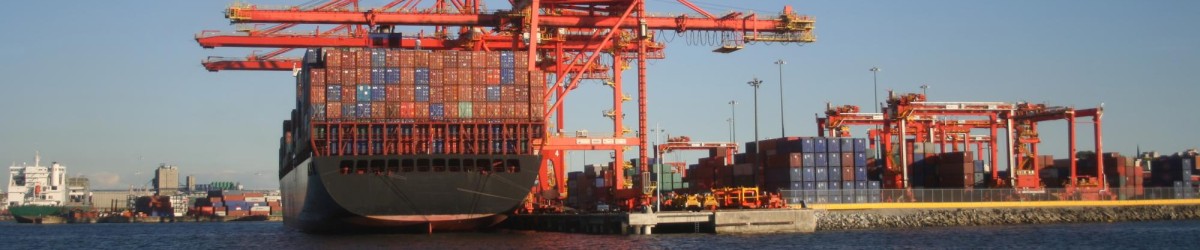
Canada’s economic prosperity depends on trade. But global maritime shipping networks have been reshaped in ways that have reduced Canada’s relative connectivity and carrying capacity. This less-central role for the country could mean greater exposure to supply chain disruptions that could increase the cost of doing business.
Over the past decade, trade patterns have shifted, redefining the role Canadian ports play in global shipping networks.
We can take stock of these changes by tracking the movements of ships over time to discover which ports have become major hubs. This is important to understand how easily goods can reach markets and how resilient trade links are to disruptions.
We analyze an innovative dataset about ship movements and find that, between 2016 and 2023, Canadian ports became less directly connected to global shipping networks than ports in other countries. This has increased the chances that foreign supply chain disruptions—especially at distant hubs—impact domestic markets and prices.
Canadian ports have become less central in global shipping networks
Our analysis uses satellite data from exactEarth Ltd. that provide the precise location, several times each day, of shipping vessels around the world in 2016 and in 2023. We then use data science algorithms to measure how long each ship stayed within a specific range of a port. This allows us to chart major shipping routes and identify changes over this time period. We focus on two clearly identifiable types of ships: conventional container ships and ships designed to transport motor vehicles.
We then use these data to calculate the degree centrality, an indicator of the number of unique destinations directly connected to a port. A port with a low degree centrality might have only a few dedicated routes. But a port with a high degree centrality may be a vital, globally connected shipping hub.
We also assign a weight to each trade route, based on the number of vessel trips through it, to distinguish high-capacity corridors from minor connections. And we normalize the results so we can show a port’s connectivity as a share of overall maritime trade.
We find that degree centrality declined considerably for each of Canada’s top five ports between 2016 and 2023 (Chart 1). This means that Canadian ports became relatively less central in global shipping networks compared with what they once were.
Chart 1: Canadian and US ports have become considerably less central in global shipping networks than other ports
Normalized degree centrality, 2016 and 2023, by major port
The decline in the relative connectivity of Canada’s maritime shipping may be partly explained by recent developments in ship size. As discussed in a recent Sparks at Bank article, shipping companies are replacing aging vessels with new, larger ships that can carry more cargo. For example, the latest ultra-large container ships can carry over 20,000 standard-sized containers. But the largest ships that Canadian ports can accommodate are those that carry 15,000 containers at most. This implies that many imports coming on larger ships from southeast Asia, for example, must first travel to and be processed through the port of Los Angeles before being shipped to Canada by train or truck.
The decline in relative connectivity is not solely a Canadian issue but a North American phenomenon. Major US ports also saw decreases in their degree centrality between 2016 and 2023. In 2016, 3 ports in the United States were among the top 10 most-connected ports in the world, but none remained in the top 10 by 2023. Meanwhile, 8 of the 10 most-connected ports in 2023 were located in East Asia, up from 6 in 2016. These shifts reflect the growing prominence of trade between developing economies.
The overall capacity of ships moving through Canadian ports has declined
The capacity of ships tells us how much, in theory, can be imported to and exported from Canadian ports. A ship’s capacity depends on its type and dimensions, yielding what’s known as deadweight tonnage. But this measures potential capacity. It does not capture actual traded volumes or values. The deadweight tonnage data we use from the London Stock Exchange Group do not tell us what these ships are carrying or the share of capacity actually being used.
The total deadweight tonnage of all vessels that departed from or arrived at Canadian ports fell from 167 million metric tons in 2016 to 119 million metric tons in 2023—a decline of 28% of maritime trade capacity.
Over this period, Canada lost 11 trading partners that accounted for just over 6 million metric tons of capacity. At the same time, Canada gained 18 new partners that contributed about 3 million metric tons—not enough to make up the loss of trading partners.
Like the decline in relative connectivity, the drop in overall deadweight tonnage is a broader North American issue.
In 2016, the United States and Canada ranked 2nd and 6th in the world, respectively, for total deadweight tonnage that moved through their ports. Seven years later, their ranks were 3rd and 23rd, respectively. Of the remaining 18 countries in the top 20, 10 saw their overall deadweight tonnage more than double over that same period.
And when we examine trade with the top 20 countries, we find that Canada and the United States were among the few countries that received less total deadweight tonnage in 2023 than they did in 2016 (Figure 1).
Shifts in trade connectivity may weaken Canada’s economic resilience
Taken together, the data on decreased relative connectivity and declining overall ship capacity at ports indicate a substantive shift in the concentration of shipping services and capacity—away from Canada and the United States and toward Asia and other growing maritime hubs. Clearly, some of this shift is driven by increased trade between other countries. So to some extent, Canada’s losses are relative, not absolute.
However, relative losses in degree centrality mean that Canada has become more reliant than its competitors on global shipping networks to import and export goods. A larger share of maritime trade than before may be moving along indirect paths and through larger foreign hubs. This can lengthen transit times and make logistics more complex, which increases the risk of supply chain disruptions. It may therefore reduce the resilience of Canadian importers and exporters, potentially raising the cost of doing business.
Disclaimer
Sparks at Bank articles discuss issues relevant to the economy and central bank policy. They are produced independently from the Bank’s Governing Council. The views expressed in each article are solely those of the authors and may differ from official Bank of Canada views.
Find out more
DOI: https://doi.org/10.34989/saba-12