
Canadians usually pay their mortgages on time. But some fall behind on payments. Before they do, homeowners often increase their use of credit cards and lines of credit—and then can’t keep up on those payments.
For many Canadians, a mortgage is one of the most significant financial commitments they will ever make. While most homeowners can cover their mortgage payments, some struggle at times to keep up.
Households usually make paying their mortgage a priority. Most homeowners know that missing payments on a mortgage can lead to the loss of their home and difficulty obtaining credit in the future. The consequences for missing payments on credit cards or other debts are typically less severe, so households often put less priority on paying these debts.
Homeowners who miss a mortgage payment often do so after missing payments on their credit cards, auto loans and other credit products. So we asked ourselves: can we find specific patterns in how consumers use credit before they miss a mortgage payment?
To answer this question, we use anonymized data from TransUnion Canada, one of the two large credit bureaus in Canada. Specifically, we analyzed the credit history of 9 million Canadians who held mortgages between 2015 and 2024. Of those, close to 450,000 missed a mortgage payment at some point during this 10-year period. As we outline in our Staff analytical paper, we find that mortgage holders follow a similar sequence of changes in their use of consumer credit in the two years before missing a mortgage payment (Figure 1).
Figure 1: Typical changes in the use of consumer credit before households miss a mortgage payment
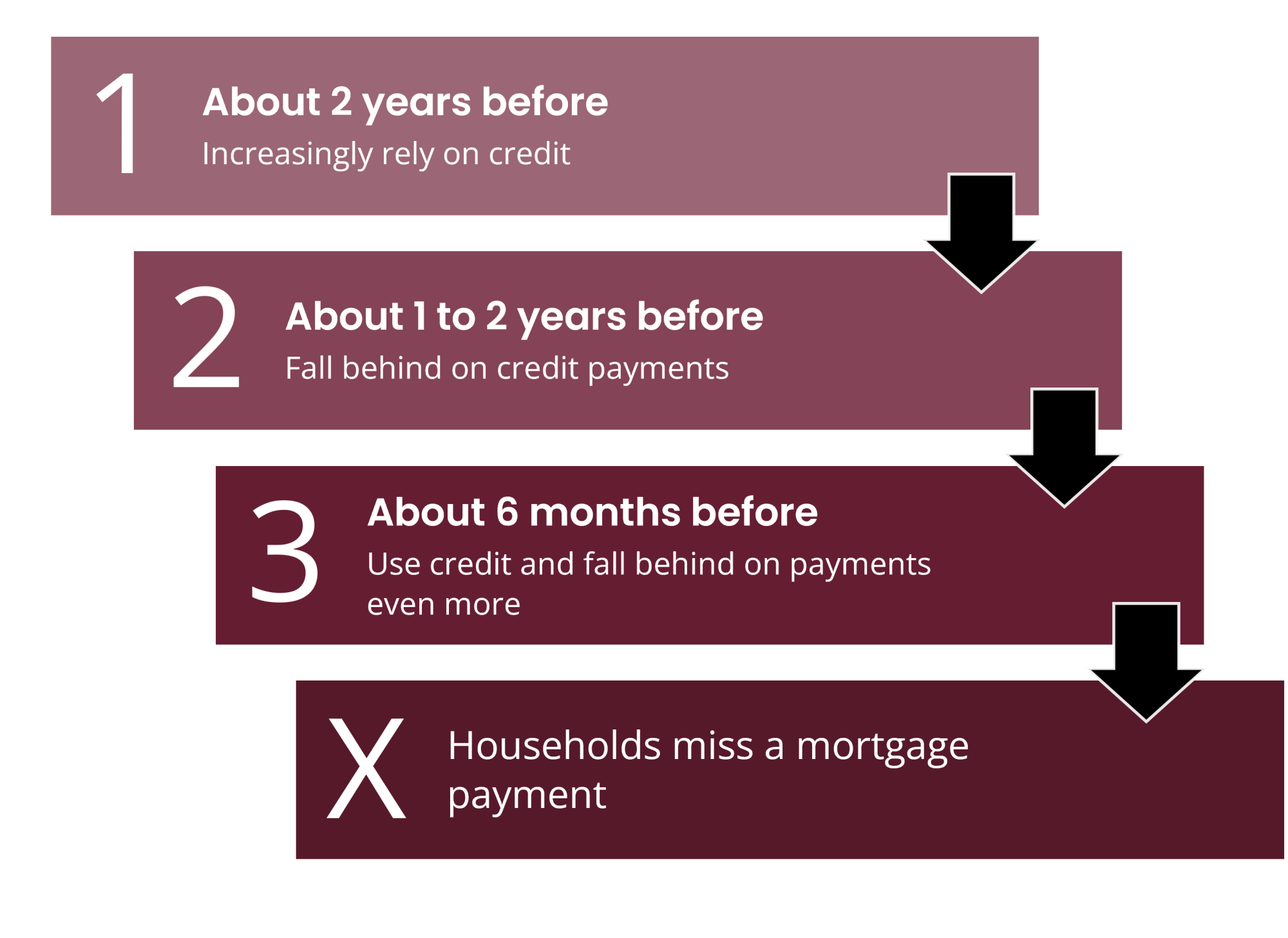
Change no. 1: Households increasingly rely on consumer credit
About two years before they eventually miss a mortgage payment, households typically expand their use of some consumer credit products, such as credit cards and lines of credit.
Chart 1 shows the usage rates of these products—calculated by taking the balance owing and dividing by the authorized credit limit. These rates begin to rise about 24 months before households miss a mortgage payment. This suggests that around this time, households start to feel financial pressure building, so they begin to rely more on their unused credit to cover their financial obligations—like insurance and utility bills—and everyday expenses.
These findings support earlier research that found reliance on credit card debt was a useful indicator to predict whether a household would face financial stress in the future.
Change no. 2: Households fall behind on consumer credit payments
Between one and two years before falling behind on their mortgage payments, some households begin to miss payments on their consumer credit products—particularly credit cards (Chart 2). This highlights the fact that consumer credit is often the first area that can signal a household is struggling to manage its financial obligations.
Change no. 3: Households rely even more on consumer credit six months before missing a mortgage payment
Six months before a household misses a mortgage payment, the behaviours described above become more pronounced. Households increasingly use and fall behind on their credit cards and lines of credit (Chart 1 and Chart 2). This indicates that households are facing greater financial strain and might be about to start falling behind on mortgage payments.
Using these findings to monitor households’ financial health
Identifying patterns in consumer credit can provide early warning signs of financial strain—to the Bank of Canada and financial institutions—before a household misses a mortgage payment. These early warnings are important because without them, household financial distress may lead to credit losses for banks. If widespread, these large-scale losses can destabilize the banking sector since mortgages are both the largest liability for households and the largest assets for banks.
The Bank’s website now provides information on many of the indicators discussed in this article, including details on the use of credit cards. Visit our Financial stability indicators page to see the data yourself.
Disclaimer
Sparks at Bank articles discuss issues relevant to the economy and central bank policy. They are produced independently from the Bank’s Governing Council. The views expressed in each article are solely those of the authors and may differ from official Bank of Canada views.
Find out more


DOI: https://doi.org/10.34989/saba-7