June 23, 2026
Adjusting for growth and resilience
Governor Tiff Macklem explains how financial risks could mix with uneven trade and investment to weaken the international system.
Good afternoon and thank you for the invitation. It’s a pleasure to be here with Paris Europlace and the Chambre de commerce France-Canada.
Six weeks ago, I was here in Paris with G7 finance ministers and central bankers. Much of our meeting focused on the conflict in the Middle East and its implications for near-term growth and inflation. The US-Iran agreement signed last week is a very welcome development and global energy prices have begun to come down, though much remains to be worked out.
We also discussed medium-term growth. We expressed concern that global imbalances are widening again, with some countries running large deficits and others running large surpluses that persist over time. And we discussed how to promote more balanced growth over the medium term. This is what I want to talk about today.
Renewed G7 focus on global imbalances began last year under Canada’s presidency and has continued under France’s leadership this year. So it seems appropriate that a Canadian central banker talk about global imbalances while here in France.
But I will acknowledge that this is not an easy topic. Global imbalances are not front of mind for households or businesses. And they are not even obviously problematic. Indeed, trade deficits and surpluses are an integral part of our mutually beneficial global system of open trade and investment.
But when imbalances are too big and too one-sided for too long, they become excessive. When needed adjustment is not happening, imbalances can spill over —and then we all feel it. Through trade and investment flows, exchange rates and asset prices, imbalances can affect employment, inflation and financial security. And they can affect more than our economies—they can affect relations between countries. Canada is not a contributor to excessive global imbalances, but we are being knocked by increased trade tensions, and we could be sideswiped if financial stability risks crystallize.
Much of the discussion about imbalances has focused on China’s large and growing trade surplus. China has relied heavily on investment and exports for growth. Overinvestment in manufacturing has created excess capacity—and the resulting hyper-competition is creating damaging deflationary forces. China’s effort to shift its excess capacity to the rest of the world through exports has sparked accusations of unfair practices and spurred demand for trade restrictions and tariffs. None of this is good for sustained growth in China and the world, or for international relations.
Imbalances may also be fuelling financial stability risks. The flip side of trade balances are capital flows. The US trade deficit must be matched with large capital inflows from other countries. And changes to the financial system may be interacting with imbalances in ways we don’t fully understand. The financial system has grown in speed, scale and complexity, and new non-bank intermediaries are playing a larger role.
It’s this link between imbalances, trade, capital flows and financial stability risks that I want to focus on today. My message is twofold.
First, we need to look at imbalances through the lens of capital flows and international investment. Imbalances and capital flows connect the international financial system, and it’s important that we understand the risks—who is exposed to them and where they sit in the system.
Second, we need to avoid overextending our international monetary and financial system. Throughout history, the system has evolved to meet new needs. But too often, change has come in response to crisis. The question is whether we adapt to a changing landscape—or wait for a crisis to force change upon us.
I will develop these themes in three parts. First, I’ll explain how the international monetary and financial system has been forged by crisis and the role that global imbalances played through history. Second, I’ll highlight key features of the current landscape and the financial pressures that are building. And third, I’ll outline practical steps we can take to support growth, foster more balanced trade and capital flows, and protect financial stability.
To understand where we are today, we need to understand where we have come from.
Before World War I, the gold standard delivered a predictability that many still idealize. Currencies were convertible to gold. This delivered stable exchange rates, but when imbalances developed, adjustment had to go through wages and prices. This meant painful periods of rising unemployment and falling wages.
World War I strained the gold standard further. Financing the machinery of war under strict gold convertibility was impossible. And it didn’t get easier after the war. Political and financial constraints were high across many countries. The underlying bargain—stable currencies in exchange for domestic austerity when needed—could not be sustained.
Eventually, countries gave up on the standard and currencies were devalued. Tariffs were imposed to protect domestic economies. But the Smoot-Hawley tariffs in the United States and the tit-for-tat retaliation weakened all our economies and amplified the collapse in global growth in the 1930s.
Following World War II, the Bretton Woods system rose from these failures and put the US dollar at the centre of global finance. The United States agreed to convert dollars held by foreign institutions into gold at a fixed price, giving the world a trusted unit for trade and reserves. Exchange rates were fixed to the US dollar but adjustable in the face of persistent disequilibrium in the balance of payments.
The Bretton Woods system worked for a while, but once again, imbalances became problematic, and domestic imperatives overwhelmed the external anchor. When foreign claims on US dollars rose at the same time as US fiscal deficits increased, policy-makers were unwilling to accept the tightening needed to defend the peg. The United States suspended convertibility in 1971, ending the Bretton Woods system of fixed exchange rates.
These failures point to some enduring lessons.
First, while trade and capital flow imbalances are part of a well-functioning system, when they become excessive, they create tensions.
Second, when imbalances are left unaddressed, they can undermine the stability of the system. When domestic goals overwhelm international rules, the rules eventually give way.
Third, trying to shift the costs of domestic imbalances to foreigners using tariffs and currency devaluations doesn’t work. The mutual harm of trade wars lowers growth and living standards for everyone.
That brings us to where we are today—a world of flexible exchange rates and deeper, more interconnected capital markets with the US dollar at the centre of the system.
Our system of flexible exchange rates and open capital markets has worked better than anything that came before. But it has not been without major bumps. The global financial crisis in 2008–09 highlighted how quickly crises travel through our interlinked financial systems. Liquidity, leverage and cross-border funding channels transmitted stress faster than trade flows ever could. Led by the G7, the world managed a coordinated response that avoided an even bigger calamity—but only when the situation was already dire.
The takeaway from this romp through global financial history? When pressure builds in the system, we can’t assume that adjustments will take place on their own—at least, not in a good way. Through history, we’ve seen that change tends to come in moments of crisis. But crises are costly and don’t guarantee positive outcomes. A better path would be to adjust the system before pressures reach a tipping point.
Global imbalances narrowed following the global financial crisis, but excess imbalances are growing once again.1
At the same time, new non-bank financial intermediaries—hedge funds, private finance companies, pension funds and other asset managers—are playing a growing role in global financing.
These two important changes to the landscape are interacting with more recent developments, including rising geoeconomic fragmentation, rapid advances in artificial intelligence (AI) and new innovations in money and finance.
Let me expand.
Global imbalances reflect domestic imbalances. China has delivered spectacular growth over the past 25 years, but savings have been much higher than investment. So capital flows out. In Europe, investment is modest compared to savings, so capital also has to flow out. The United States has been the biggest destination of capital. Strong consumption and large fiscal deficits mean Americans save less than they invest domestically. Inflows of foreign capital have financed the gap. Together with valuation effects, these have pushed the US net international investment position to an historically large negative balance.
Cross-border finance is a good thing. It supports growth by moving capital to where it’s more productive. But when flows become excessive, they can widen trade gaps, fuel protectionism and distort asset prices. Capital gets misallocated. Pressures cumulate and financial stability risks increase.
In principle, imbalances should prompt gradual adjustment. Exchange rates should change, capital and trade flows shift, and financing gaps narrow. But in practice, that adjustment can be delayed.
The role of the US dollar as the world’s reserve currency has supported deep and liquid markets. But the attractiveness of US dollars may have let imbalances persist longer than they otherwise might, allowing pressures to build and distortions to deepen. One-way flows can fuel asset bubbles—we saw this in the run-up to the global financial crisis—and we may be seeing it again with the AI boom. China is still working through the legacy of overinvestment in real estate, while in Europe, underinvestment has held back productivity. The common thread is clear: when adjustment is delayed, imbalances persist, growth is held back and risks build across the global system.
As imbalances have been building, the way capital moves across borders has also been changing. The financial system is not just bigger. It’s faster, more complex and increasingly dominated by new players that are less regulated, less transparent and less tested under stress.
After the global financial crisis, we strengthened the regulation and supervision of banks. And banks are safer. The global economy has been through a lot since the start of the pandemic in 2020 and the banking system has held up remarkably well. This is a huge benefit we don’t want to undo.
One consequence of higher standards for banks is that riskier activities have migrated to non-bank financial intermediaries that sit outside the more regulated banking sector. This growth in market-based finance has brought clear benefits: diversified risk, improved access to credit and increased efficiency.
But risks haven’t disappeared—they’ve moved. And our global surveillance and regulatory frameworks haven’t kept pace with the change. Non-bank players generally don’t face the same reporting requirements or level of monitoring as banks. That gap poses a challenge for global standard-setters, national regulators and central banks.
Hedge funds have become important buyers of the debt issued by governments around the world. This has helped absorb more issuance and improved market efficiency. But the leveraged trading strategies of these investors, combined with short-term funding and more cross-currency trades, may be making this core market more fragile and increasing the potential for contagion across countries.
New forms of money are also allowing money to move more quickly through the financial system. In advanced economies, fintechs are applying for banking licences and incumbent banks are offering new crypto products. And in emerging-market economies, US-dollar stablecoins are increasingly used for cross-border transactions. While this may lower costs, it also allows capital flows to reverse more quickly—often beyond the line of sight of authorities and beyond the reach of capital controls.
As the financial system evolves away from a bank-centred and well-supervised world toward one that is faster, more opaque and more interconnected, gaps may be opening up between jurisdictions, instruments and institutions.
That leaves us with two clear risks. First, large capital inflows into the United States could once again be misallocated—stretching valuations in equities and credit and setting the stage for a painful correction. Second, those flows could reverse suddenly. Either outcome could send stress far beyond US borders.
So the problem is not just that imbalances are widening again. It is also that they are widening in a world where the financial system is now faster, more complex and less transparent.
What does all this mean for our future?
If there is one lesson to take from history, it’s that adjustment delayed eventually becomes adjustment imposed—in far more disruptive ways. We saw that in the years between World War I and II. Imbalances built up and cooperation broke down. As countries turned inward, the result wasn’t resilience. It was fragmentation and instability.
Today, large, persistent imbalances are once again fuelling tensions—through trade, capital flows and financial markets. And the question is whether we address them deliberately or they unwind in ways we cannot control.
The first step is to agree on the problem. And here there is a growing consensus that global imbalances are rooted in domestic imbalances in the largest jurisdictions.2 Reducing these imbalances requires China to consume more, the United States to save more, and Europe to invest more.
Addressing domestic imbalances is in each country’s best interest. Addressing imbalances in a coordinated way will increase the benefits to all. Adjustment will be smoother and more durable if it is shared. As the United States reduces its fiscal deficit—and its reliance on capital inflows—Europe and China will need to do their part by reducing excess savings through stronger domestic investment and consumption.
There are some encouraging signs. China’s new five-year plan emphasizes strengthening consumption. Europe has a path to increase integration and invest more, including in infrastructure and defence. And the United States aspires to have a lower fiscal deficit.
Of course, real progress requires moving from aspiration to action to adjustment. And adjustment will take time.
So what can we all do to support adjustment and protect financial stability? I see three priorities: openness, investability and transparency.
First, openness. Even as the United States has pulled back from open trade, others—like Canada and the European Union—should look to deepen trade and investment relationships. An open global system allows capital to flow where it is most productive, supports growth and helps economies adjust to changes in domestic supply and demand. But we know from history that support for openness weakens when imbalances rise—or when openness itself is perceived as a weakness. Protectionism seems to offer relief, at least in the short term. But the clear message from history is that it comes at a big cost, reducing efficiency and fragmenting markets in a way that hurts us all.
Second, investability. Right now, a huge share of global savings flows into the United States. That means global savings are pulled disproportionately in one direction. If we want a more balanced and resilient global system, we need to create more places for those savings to go. That means developing more safe assets—as well as payments infrastructure that is fast, secure and convenient for all our currencies. It means making investment outside the United States more attractive, with better conditions for firms to scale. That comes through strong institutions, open capital accounts, the rule of law, and a policy environment that removes barriers that impede productivity or hold back growth. In Canada, this includes eliminating interprovincial trade barriers and reducing regulatory uncertainty.
Third, transparency. The system works better when risks and spillovers are visible. There are blind spots in how trade is measured, in international investment positions and, ultimately, in who holds what. And markets can’t price what they can’t see.
The private sector is the first line of defence—and market participants generally do a good job of managing the risks they face individually. But systemic risks can build beyond the line of sight of any single firm. And financial authorities need visibility to supervise effectively.
How do we improve transparency? It starts with better data—especially in the parts of the system that move fastest under stress: non-bank financial intermediaries, foreign exchange markets, and cross-border capital flows. It also means stress testing that reflects how fast and interconnected the system is today—and sharing the results with the private sector. And it requires international institutions—like the International Monetary Fund, the Financial Stability Board and the Bank for International Settlements—to work together so we can all see risks earlier.
We should not let pressures continue to build. And we should not repeat the mistakes of the interwar years. We can still support open trade and investment, deeper ties and stronger cooperation—so that we can adjust earlier and build a more resilient global system.
I’ll end with a simple point: resilience is a choice. It doesn’t happen automatically, and it doesn’t come from good intentions. It comes from reinforcing systems so they don’t break in times of stress.
Global imbalances are increasing vulnerabilities. Trade friction gets a lot of attention, but frictions are also building in global finance. If we respond by working together to identify and diffuse financial stability risks and foster more investable markets in all our economies, we promote adjustment and safeguard all our economies against the next crisis.
The responsibility is shared—public and private, domestic and international. If we can get it right, we’ll have a global financial system that channels savings to the most productive investments, increasing growth. And we’ll have a system that supports adjustment instead of amplifying stress.
Thank you.
I would like to thank Patrick Alexander and Geoffrey Dunbar for their help in preparing this speech.
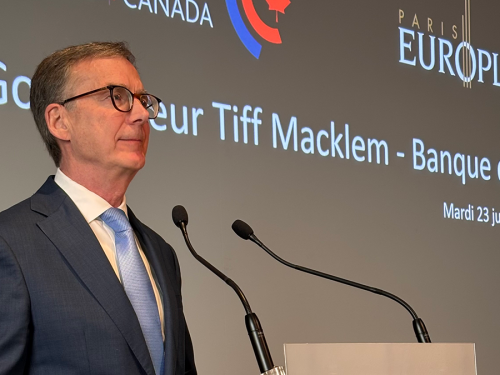

The global financial system — Governor Tiff Macklem speaks before the France-Canada Chamber of commerce and Paris Europlace (9:40 (ET) approx.).
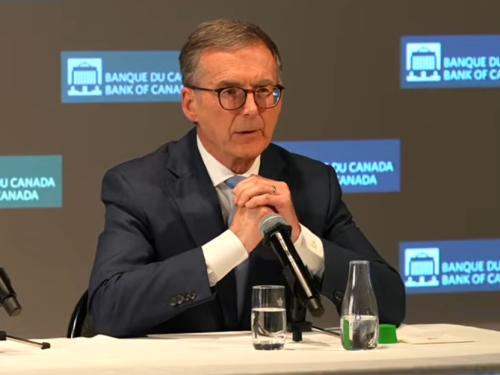
The global financial system — Governor Tiff Macklem takes questions from reporters following his remarks (10:50 (ET) approx.)
We use cookies to help us keep improving this website.