Introduction
The Real Return Bond (RRB) program was created in line with the Government's fundamental objective of raising stable, low-cost funding. The ultimate goal of the program is to diversify the Government's marketable funding sources in a cost-effective manner and attract investors to Government of Canada securities which, in turn, keeps borrowing costs low.
The Government is conducting a review to determine whether the program has achieved and, more importantly, will achieve its intended objectives. This document contains background information for consultations, focusing on preliminary results of a technical paper in progress. It focuses on two of the program's objectives, as a cost-effective funding method and as a way to diversify the Government's investor base.
RRB cost-effectiveness is compared to nominal bonds using a number of accepted methods. The analysis looks at the relative costs of past issuance of RRBs and nominal bonds and the estimated relative costs of future RRBs-and-nominal-bonds. A historical examination of the primary market for RRBs is also used to assess whether improvements in demand and liquidity are expected to enhance future long-term cost-effectiveness.
The results of the cost-effectiveness study show that the RRB issues to date are projected to produce cost-savings relative to nominal bonds. The examination of primary and secondary markets indicates the demand for RRBs has improved since the program's inception.
Program Objectives
In December 1991, the Government of Canada began issuing inflation-indexed debt securities called Real Return Bonds. At the inception of the program, the Government outlined a number of objectives of the RRB program. These were:
- Cost-effectiveness compared with other sources of funds
- Diversification of the marketable bond program for the Government
- Broader selection of instruments provided to investors and diversification of the investor base
- Secondary market development
- Anti-inflation stance signal to the market
- Indicator of real return and long-term inflation expectations
History of Operations
The first RRB operation for the 1 December 2021 issue, with a 4.25% per annum coupon, raised $700 million. The issue was reopened ten times from December 1991 to August 1995, raising between $325 million to $600 million per operation, until $5.2 billion of the issue was outstanding. A total of $5.0 billion was raised from the operations. All but the last two reopenings were sold through syndicates of dealers. Starting in May 1995, RRBs were sold through uniform price (Dutch) auctions.
In December 1995, the Government began issuing another RRB maturity, due 1 December 2026, with a 4.25% per annum coupon. Twelve reopening auctions were conducted, one in each quarter between March 1996 and December 1998, resulting in a total of $5.3 billion outstanding and funding of $5.2 billion. The third RRB maturity, due 1 December 2031, has raised $6.6 billion through quarterly auctions over the period March 1999 to March 2003, through $5.8 billion of issuance. A fourth RRB maturity was issued in June 2003 with a coupon of 3.00% and a maturity on 1 December 2036.
Table 1: RRB Gross Issue Amounts (excludes CPI adjustment) as of July 2003
| Maturity date | Amount ($ millions) |
Coupon Rate (%) |
|---|---|---|
| 1 Dec. 2021 | 5,175 | 4.25 |
| 1 Dec. 2026 | 5,250 | 4.25 |
| 1 Dec. 2031 | 5,800 | 4.00 |
| 1 Dec. 2036 | 400 | 3.00 |
| Total Real Return Bonds | 16,625 | About 4-5% of total market debt |
| Total C$ Marketable Debt | 413,577 | Sources: Bank of Canada and Department of Finance |
Relative Funding Cost of RRBs
Two basic methods 1 are used to compute the relative cost to the Government of selling RRBs rather than nominal bonds over the period December 1991 to December 2002. The results of both methods, depicted in Table 2 and Figure 1, are very similar.
- From the start of the program in 1991 to the mid-1990s, the Government experienced lower projected funding costs with RRBs and was compensated for taking on inflation expectation risk.
- The projected relative cost savings began to slowly decline through the mid-1990s and, by the late 1990s RRB costs were higher than nominal bonds.
- The projected relative costs at recent auctions indicate that RRBs have become marginally cost-effective.
Table 2: Expected Relative Costs/Savings (Break-Even Inflation Rate method), $ Millions
| Maturity | Current Cost/Saving to Dec. 2002 | Total expected cost/saving with long-run inflation at 2% | Break-even Inflation Today |
|---|---|---|---|
| 1 Dec. 2021 | -1,500 | -3,300 | 5.3% |
| 1 Dec. 2026 | -100 | -400 | 2.5% |
| 1 Dec. 2031 | 100 | 100 | 1.9% |
| Total Cost | -1,500 | -3,600 | 3.2% |
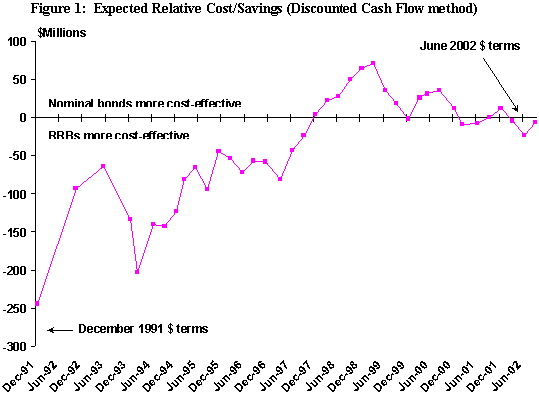
- Collectively, the cost savings of RRBs issued to the end of 2002 are in the order of $1.5 billion. During this period, $15 billion of RRBs were issued.
- Given the assumption of realized inflation of 2% over the remaining life of previously issued RRBs, these RRBs are projected to result in cost savings for the Government. The expected savings for the 2021 and 2026 RRB issues are about $3.7 billion. The 2031 issue is expected to cost the Government $0.1 billion.
- The total savings of existing RRB issues analyzed are projected to be around $3.6 billion.
Considerations: The cost-effectiveness of RRB issues is not only dependent on inflation expectations but also the difference in nominal and RRB yields. For example, the first two RRB issues have provided the Government with debt cost savings by avoiding large inflation risk premiums embedded in long nominal yields. Since the early-to the mid-1990s, long nominal yields have declined and in recent years both nominal and real yields have remained relatively stable. This compression in the difference between nominal and RRB yields has reduced the Government's compensation for taking on inflation expectation risk, particularly for the 2031 issue.
Simulations of the future cost of new RRB issuance indicate that, if inflation rates turn out as expected, RRBs will likely remain marginally cost-effective relative to nominal bonds, and if inflation rates come in different than expected (i.e., higher or lower) and/or nominal-RRB yield spreads move from current levels, then there will be changes in RRB funding costs relative to current projections.
Diversification of Investor Base
Diversifying the Government's investor base leads to a more attractive market for Government of Canada securities. In turn, this results in greater investor interest and lower borrowing costs. A historical review of RRB auction results and secondary market activity suggests that the demand and liquidity have improved with the stock outstanding, but there remains a liquidity challenge given the buy-and-hold nature and concentration of RRB investors.
Primary Market: To assess the performance of RRBs as a funding source, we compare bid-coverage ratio, auction participation, and bid aggressiveness achieved at RRB auctions to those achieved at nominal bond auctions. As well, yield behaviour pre- and post-auctions are examined.
- The bid-coverage ratio has improved over time and has recently been consistently higher than for 30-year nominal bonds. From June 1997 to March 1999, there were three auctions with coverage less than 2x, with the lowest coverage occurring in June 1997 (1.6x). Market participants are more active at RRB auctions as RRBs trade less frequently on the secondary market than nominal bonds.
- Customers have a high level of participation at RRB auctions relative to their participation at nominal bond auctions and accounted for 51% of RRB auction awards over the period between 1995-2002. Thus, dealers' awards at RRB auctions counted for 49% compared to more than 85% for nominal bonds over the same period.
- RRB bids at auction submitted between July 1999 and December 2002 were more aggressive than the ones submitted before July 1999, but were less aggressive than bids at 30-year nominal bond auctions 2.
- On average, pre-auction yields fell 0.9 basis points during the three days preceding each auction over the period April 1995 to December 2002. Over the same period, RRB post-auctions yields, fell by about 1.1 basis points, on average, during the six days following each auction. The pre- and post-auction yield behaviour results are indicative of an environment where demand is greater than supply.
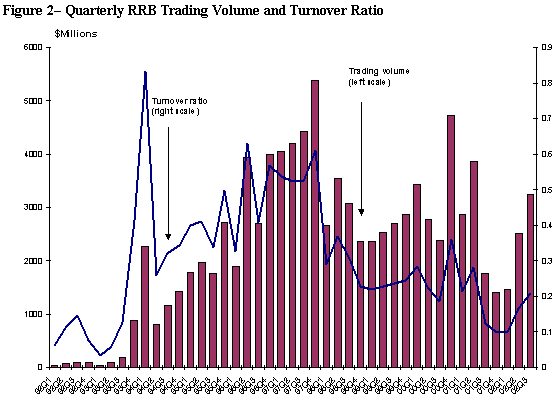
Secondary Market: Activity on the RRB market has been limited since the inception of RRB products. Most trading activity takes place between dealers and buy-and-hold investors and the trading volume of RRBs on the secondary market is low when compared to other fixed-income products. However, trading activity in the RRB secondary market has improved since the inception of the products (Figure 2).
Investor Base: RRBs continue to attract specific types of investors, particularly those with inflation-indexed liabilities such as pension funds and insurance companies.
- A Pension Investment Association of Canada survey reported that, at the end of 2001, pension funds held about 67% of the total RRB stock outstanding 3. By comparison, pension funds held less than a quarter of the domestic holdings of the Government's marketable debt by the end of 2001 4.
- There has been some evidence of increased foreign participation in the Canadian RRB market in recent auctions and anecdotal evidence of continued foreign participation.
Funding Source: The RRB program has diversified the portfolio of financing instruments available to the Government, although the stock of RRBs remains a small portion of the debt. As of July 2003, the stock of RRBs accounted for about 4-5% of market debt, an increase of 2 percentage points from 1997.