Bank of Canada Review - Summer 2002
BoC Review - Summer 2002

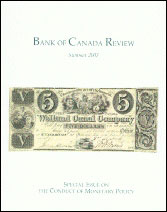
Cover page

Welland Canal Note

The note, signed by Merritt as company president, measures 184 mm by 82 mm and forms part of the National Currency Collection, Bank of Canada.

Photography by James Zagon, Ottawa.

  1. Monetary Policy and Uncertainty

    Bank of Canada Review Article - Paul Jenkins, David Longworth

    Central banks must cope with considerable uncertainty about what will happen in the economy when formulating monetary policy. This article describes the different types of uncertainty that arise and looks at examples of uncertainty that the Bank has recently encountered. It then reviews the strategies employed by the Bank to deal with this problem.

    The other articles in this special issue focus on three of these major strategies.

    Topics: Monetary policy framework; Uncertainty and monetary policy
  2. Information and Analysis for Monetary Policy: Coming to a Decision

    Bank of Canada Review Article - Tiff Macklem

    This article outlines one of the Bank's key approaches to dealing with the uncertainty that surrounds decisions on monetary policy: the consideration of a wide range of information from a variety of sources. More specifically, it describes the information and analysis that the monetary policy decision-makers—the Governing Council of the Bank of Canada—receive in the two or three weeks leading up to a decision on the setting of the policy rate—the target overnight interest rate. The article also describes how the Governing Council reaches this decision.

    Topics: Monetary and financial indicators; Monetary policy framework; Monetary policy implementation
  3. Models in Policy-Making

    Bank of Canada Review Article - Donald Coletti, Stephen Murchison

    This article examines another strategy in the Bank's approach to dealing with an uncertain world: the use of carefully articulated models to produce economic forecasts and to examine the implications of the various risks to those forecasts. Economic models are deliberate simplifications of a complex world that allow economists to make predictions that are reasonably accurate and that can be easily understood and communicated. By using several models, based on competing paradigms, the Bank minimizes policy errors that could result from relying on one view of the world and one philosophy of model design. The authors review some of the models currently used at the Bank, as well as the role of judgment in the projection process.

    Topics: Economic models
  4. The Role of Simple Rules in the Conduct of Canadian Monetary Policy

    Bank of Canada Review Article - Denise Côté, Jean-Paul Lam, Ying Liu, Pierre St-Amant

    The third strategy employed by the Bank when dealing with uncertainty is the consideration of appropriate simple reaction functions or "rules" for the setting of the policy interest rate. Since John Taylor's presentation of his much-discussed rule, research on simple policy rules has exploded. Simple rules have several advantages. In particular, they are easy to construct and communicate and are believed by some to be robust, in the sense of generating good results in a variety of economic models.

    This article provides an overview of the recent research regarding the usefulness and robustness of simple monetary policy rules, particularly in models of the Canadian economy. It also describes and explains the role of simple rules in the conduct of monetary policy in Canada.

    Topics: Uncertainty and monetary policy
Copyright © 1995 - 2013, Bank of Canada. Terms of Use.