Bank of Canada Review - Autumn 2001
BoC Review - Autumn 2001

Cover page

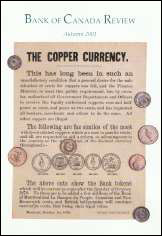
Coppers to Cents

The notice measures 9 by 12 inches. It and the coins and tokens appearing on the cover form part of the National Currency Collection, Bank of Canada.

Photography by James Zagon.

  1. A New Measure of Core Inflation

    Bank of Canada Review Article - Tiff Macklem

    While the Bank of Canada's inflation-control target is specified in terms of the rate of increase in the total consumer price index, the Bank uses a measure of trend or "core" inflation as a short-term guide for its monetary policy actions. When the inflation targets were renewed in May 2001, the Bank announced that it was adopting a new measure of core inflation. This measure excludes the eight most volatile components of the CPI and adjusts the remaining components for the effect of changes in indirect taxes.

    In this article, the author discusses the definition of the new measure of core inflation and describes some of its advantages relative to the previous measure. He notes that the new measure has a firmer statistical basis, has a better correspondence with economic theory, and does a better job of predicting future changes in overall inflation. While the new measure has these advantages, the Bank will continue to monitor a broad range of indicators when assessing the likely future path for inflation.

    Topics: Inflation targets
  2. Predictability of Average Inflation over Long Time Horizons

    Bank of Canada Review Article - Allan Crawford

    Uncertainty about the level of future inflation adversely affects the economy because it distorts the savings and investment decisions of households and businesses. Since these decisions typically involve planning horizons of many years, the adverse effects from inflation uncertainty can be reduced by adopting a policy framework that makes future inflation more predictable over long time horizons.

    When the inflation-control target was renewed in May 2001, the agreement affirmed that monetary policy will be directed at moving inflation to the 2 per cent midpoint of the target range over a six-to-eight-quarter horizon. The author describes how this policy commitment increases the predictability of average inflation over periods longer than one year. This relationship is illustrated using the Canadian experience from the inflation-targeting period.

    Topics: Inflation targets
  3. Factors Affecting Regional Economic Performance in Canada

    Bank of Canada Review Article - Brigid Brady, Farid Novin

    This article examines three shocks that affected Canada's economy over the past year from a regional perspective. The downturn in the U.S. economy, high energy prices, and low lumber prices affected Canada's regions to varying degrees. The relative size of the various economic sectors in each region is important in determining the intensity of a region's response to an economic shock.

    The article presents some stylized facts on the sectoral mix of each region followed by an analysis of the effects of the three shocks on the regional economies. An outlook is presented, which highlights the results of the survey by the Bank's regional offices in the summer of 2001.

    Topics: Regional economic developments
  4. Conference Summary: Revisiting the Case for Flexible Exchange Rates

    Bank of Canada Review Article - Lawrence Schembri

    This article summarizes the proceedings of an international research conference hosted by the Bank of Canada in November 2000. The conference marked the fiftieth anniversary of Canada's adoption of a flexible exchange rate, and its title recognizes the seminal contribution of Professor Milton Friedman's article "The Case for Flexible Exchange Rates." His keynote address to the conference is also summarized in the article.

    The conference papers re-examine many of the arguments raised by Friedman using recent developments in economic theory and econometric techniques. They investigate the experience of a wide range of industrialized and emerging-market economies. The main findings are that a strong case can be made for flexible exchange rates in economies that are large commodity exporters and that have credible low-inflation monetary policies and relatively well-developed financial systems.

    Topics: Exchange rate regimes; Exchange rates
Copyright © 1995 - 2013, Bank of Canada. Terms of Use.